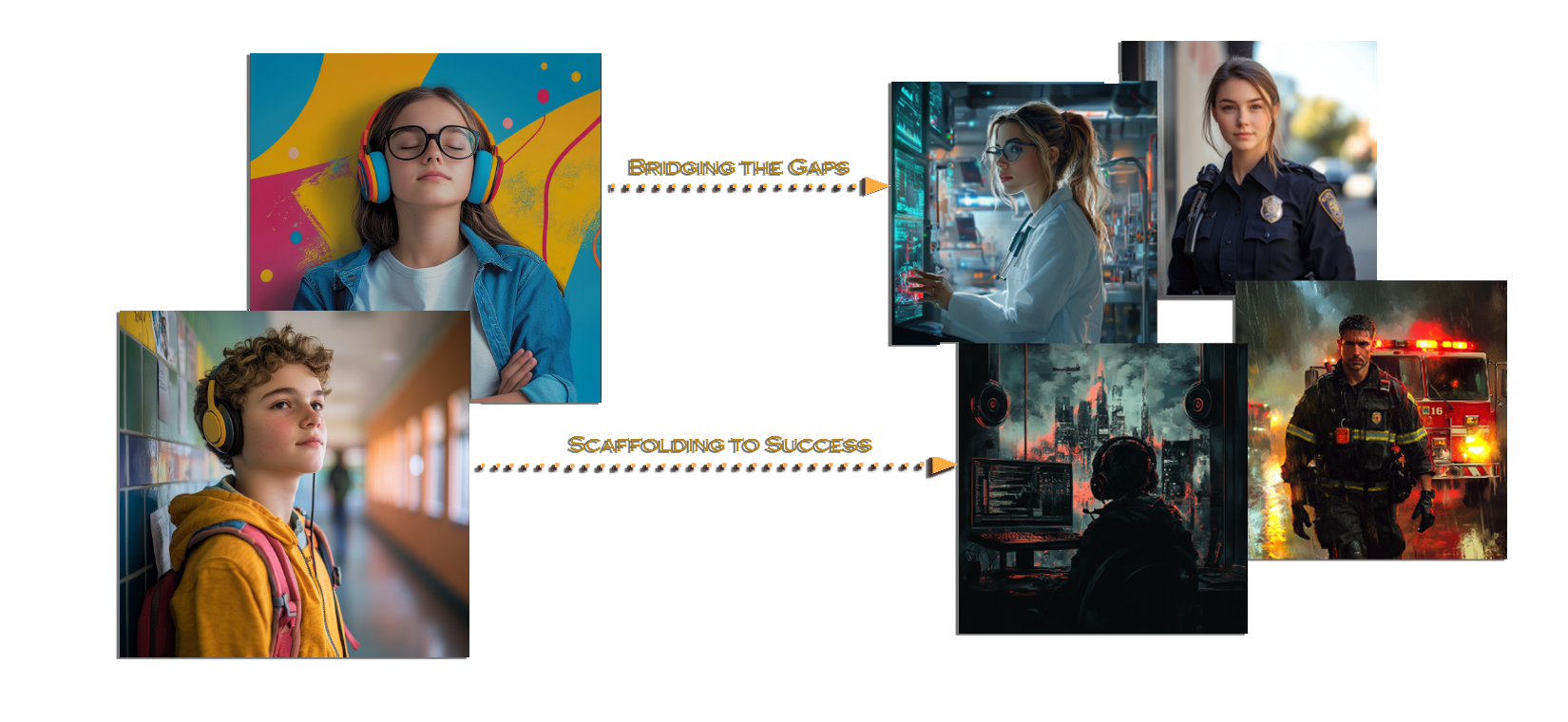

Our Current Challenges
Students of special education in the US are currently facing significant—and worsening—political, economic, and technological challenges.
What are the Gaps?
Many students, parents, and teachers encounter challenging gaps within the current education system. Guardian Airwaves LLC aims to address and reduce these gaps by providing targeted product solutions.

ADHD diagnoses are rapidly rising.*
7.1 million U.S. youths (ages 3–17) have ‘ever been’ diagnosed with ADHD, and 6.5 million’ of those currently have it. Among those with current ADHD, 77.9% — about 5.1 million children — had at least one co-occurring disorder, most commonly behavioral or conduct problems (44.1%), anxiety (39.1%), learning disability (36.5%), developmental delay (21.7%), and depression (18.9%).
1 in 10 enrolled K–12 students currently have ADHD.
Besides these personal struggles, students and their families are faced with the following:
- Achievement Gaps
- Teacher Shortages & Inequities
- Unequal Access to Higher Education
- Curriculum Gaps
- Social & Emotional Learning (SEL)
- Technology Gaps
- Special Education Needs
- Lack of Vocational Education Opportunities
- Language Barriers among migrant or international students
Note: Although 2024 CDC studies show 7 million children have current diagnosis of ADHD, we are citing 2022 CDC studies to keep survey measurements consistent through out the website.
Sources: CDC Stacks 2022, Danielson et al. 2024; childstats.gov, 2022 National Survey of Children’s Health.

In a South Korean study, ADHD may be a significant risk factor for developing smartphone addiction. Excessive smartphone use has been associated with numerous psychiatric disorders.
Source: pmc.ncbi.nlm.nih.gov/articles/PMC6408841/
See more on EduBytes
Majority of U.S. States are in Need
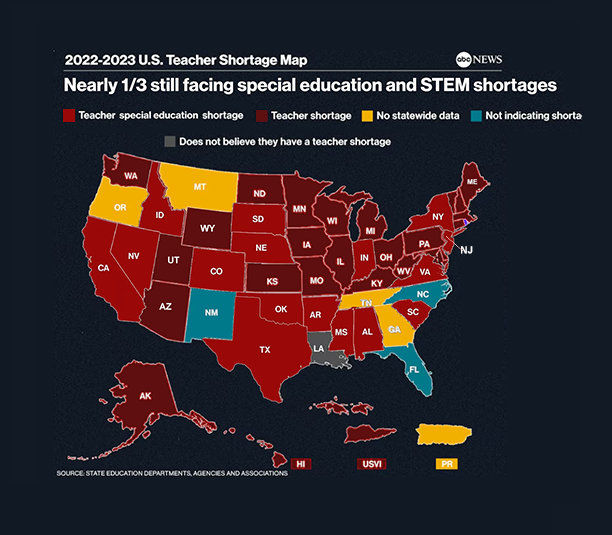
The majority of US states in yellow are in great need for support for their kids but yet there is a huge shortage of special ed teachers due to burnout, heavy workloads and now non-existent budgets. Many special education teachers report:
- Feeling isolated and unsupported
- Heavy Workload
- Low Pay
- Burnout
- Need for Professional Development
- The Bureau of Labor Statistics projects a need for 37,600 new special education teachers from 2020 to 2030 to meet growing demand.* Hiring of teachers is not increasing.
Sources:
Edweek.org/teaching-learning/why-special-education-teachers-quit-and-what-schools-are-doing-about-it/2024/
BLS Occupational Outlook Handbook 2022-23 – Special Education Teachers
A. Mockovciak, G. McKeithan, X. Johnson, D. Grisworld and M.O’Rivera. Special Education Teacher Attrition. Glob J Intellect Dev Disabil. 2023; 11(3): 555811. DOI:10.19080/GJIDD.2A23.11.555811
ies.ed.gov/learn/blog/special-educator-shortage-examining-teacher-burnout-and-mental-health
Overall Neurodevelopmental Disorders (NDDs)
More than 60 million Americans — roughly 18%, nearly 1 in 5 — identify as neurodivergent.
Source: Understood.org / Kantar MONITOR 2024
But let’s keep the focus on our kids. The table below shows the neurodiversity that represents children ages 3-17.
| Statistic | % | Simple Ratio |
| All U.S. children ages 3–17 (~62 million) | ||
| Ever diagnosed with | 11.4% | 1 in 9 children |
| Currently have ADHD | 10.5% | 1 in 10 children |
| Children ages 3–17 with current ADHD (6.5 million) | ||
| Have ≥1 co-occurring disorder | 77.9% | nearly 4 in 5 |
| Have 2 or more | 51.0% | 1 in 2 |
| Behavioral or conduct problems | 44.1% | nearly 1 in 2 |
| Anxiety | 39.1% | about 2 in 5 |
| Learning disability | 36.5% | more than 1 in 3 |
| Developmental delay | 21.7% | about 1 in 5 |
| Depression | 18.9% | nearly 1 in 5 |
About 1 in 9 kids in the U.S. have been told by a doctor at some point that they have ADHD (that’s around 7.1 million kids), and about 1 in 10 kids (6.5 million) still have ADHD now. Of those kids who currently have ADHD:
-
More than half (58%) have moderate or severe symptoms.
-
More than three-quarters (78%) also have another condition, like anxiety, learning problems, or depression.
-
About half (54%) take ADHD medicine.
-
Almost half (44%) got behavioral therapy in the last year.
-
Nearly one-third (30%) didn’t get any ADHD-specific treatment.”*****
*****https://www.cdc.gov/adhd/data/index.html
In total, 78% of children with ADHD had at least 1 other reported mental health/neurodevelopmental disorder (compared with 11% in the population without ADHD).” The study analyzed 61,779 children, identifying 5,028 (8.2%) with ADHD
Danielson et al., CDC | 2022 NSCH
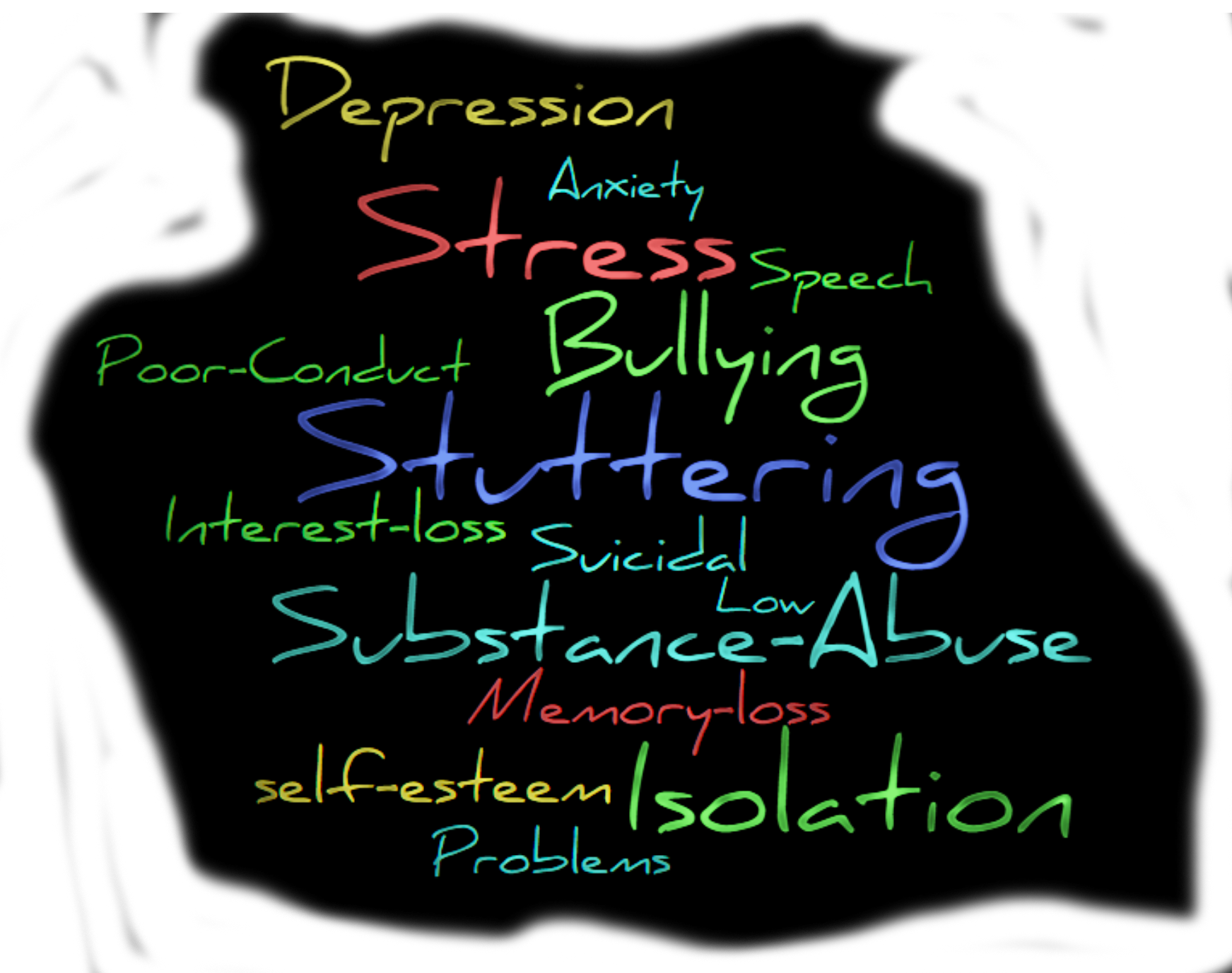
Why Should Parents & Teachers Care?
Educational Outcomes
Children diagnosed with ADHD are far less likely to complete a four-year degree — and the gap opens early.
- Only 29.5% of young adults with childhood ADHD enrolled in a four-year college, compared with 76.8% of their non-ADHD peers.
- They were nearly 11 times more likely to enroll in no school at all than to enroll in a four-year college (odds ratio 10.87, 95% CI 4.95–23.81).
- 44% attended a vocational/technical school or a junior/community college, compared with 18% of the comparison group.
- By ages 23–32, only 15% had earned a four-year degree, compared with 48% of the comparison group.
- Among those who started at a community college, just 17% had transferred to a four-year college by ages 23–32, compared with 58% of the comparison group. 56% were still enrolled in community college, compared with 25%.
Why Should Our Nation’s Workforce Care?
Occupational Outcomes
The educational gap carries into the workforce. Between ages 23 and 32, young adults with childhood ADHD were concentrated in lower-skilled work and lost jobs more often.
-
16.6% were neither employed nor in school, compared with 2.4% of the comparison group, roughly 11 times more likely to be out of both work and school.
-
72.5% were working in unskilled occupations, compared with 36%. Only 5.6% held professional roles, compared with 20%.
-
61% had been fired at least once, compared with 43%.
-
33% had been laid off at least once, compared with 13%.
-
53% had quit a job because they disliked it, compared with 36%.
Source: Kuriyan et al. (2013), Journal of Abnormal Child Psychology, 41(1), 27–41. Pittsburgh ADHD Longitudinal Study. Males only,with median age of 19.
Our Solutions
Our solutions are rooted in the Education Technology (EdTech) sector, where we integrate adaptive learning systems with each learner’s distinct method of active knowledge consumption and retention. Using conversational interfaces, computer vision, and state-of-the-art hardware, we help learners engage meaningfully, retain critical information, and apply what they’ve learned when it counts.
Through sustained focus on these foundations and a commitment to innovation aligned with evolving market demands — Guardian Airwaves aims to drive substantial, measurable impact across both special education and public safety. The result is an intelligent, student centered experience with an agentic IA* system operating invisibly in the background.
This is not a typo for AI. IA stands for Intelligent Augmentation.
An Intelligent Student Centered Experience with an Agentic IA** system operating invisibly in the background.
**Intelligent Augmentation.
An Intelligent Student Centered Experience with an Agentic IA** system operating invisibly in the background.
**Intelligent Augmentation.
What Is Intelligent Augmentation? Intelligent Augmentation (IA) combines human judgment with computer intelligence to help people learn and perform better — together. Instead of computers replacing teachers, mentors, or trainers, IA keeps humans actively involved in every decision about how technology gets used. That principle mattered even more after COVID 19, when it became clear just how much learners depend on the people around them — not just for instruction, but for emotional and social support. -Judi Fusco, Pati Ruiz, and Jeremy Roschelle, March 2021 ACM
Guardian Airwaves didn’t just adopt this idea. We built our entire company around it, on two very different frontlines. In public safety training, IA means a system that reads stress and performance signals in real time and delivers guidance in the field or simulation while the responder, not the algorithm, makes the call. In the classroom, IA means a system that reads attention and engagement signals in real time and gives teachers a clear, actionable nudge while the teacher, not the algorithm, decides what happens next.
How Guardian Airwaves Uses This Idea
Guardian Airwaves builds every feature around IA, keeping teachers’ expertise and students’ own voices at the center of every design decision. Our systems save educators and trainers time on repetitive work — scheduling, monitoring, grading, tracking so they can spend their energy where it matters most: teaching, coaching, and being present for the breakthrough moments. When a student starts to lose focus, or a trainee’s performance signals fatigue or stress, the platform notices and suggests a specific, human reviewed way to re-engage.
Why Human Judgment Still Matters
AI can be powerful, but at Guardian Airwaves, people always have the final say — over what technology gets adopted, and over how its effectiveness is judged. IA was never about letting computers make the calls. It’s about putting human judgment at the center of every classroom, every training simulation, and every moment that matters.
Same method. Same conviction.
Technology should sharpen human judgment, never replace it.
Bridging the gaps
for Middle School & High School Students
Adaptive Learning for ADHD, NDDs, Autistic Students
Our intelligent system weaves students, teachers, and parents into the fabric of the educational experience, making seamless collaboration and true support possible at every stage. Each individual’s learning journey becomes both deeply personal and brilliantly interconnected.
LEARN MORE
MIRST
Mixed Interactive Reality Simulation Training for Firefighters & First Responders
MIRST - Mixed Interactive Reality Simulation Training for Firefighters & First Responders
Virtual Reality technology was the natural progression in impactful simulation training. Developed with a retired CalFire Division Chief and Emergency Medical Response Instructor, these modules were tested by 37 firefighters and proved to be the most cost-effective and accessible way to train for dynamic unpredictable threats of climate change.
LEARN MORE
